


Wealth Aggregation as the Foundation for Personalized Advisory: wealthAPI in the Fincite WealthTech Radar 2026
Susanne Krehl, Chief Growth Officer at wealthAPI, contributed a guest chapter on Wealth Aggregation to this year’s WealthTech Radar 2026 by Fincite. The report brings together perspectives from twelve industry experts on the technological and regulatory developments set to shape European wealth management in the years ahead.
What Wealth Aggregation Deliver
Wealth Aggregation refers to the digital consolidation of all relevant financial data belonging to a client: bank accounts, securities portfolios, insurance policies, pension products, and non-financial assets such as real estate, artwork, and private equity holdings. Via API interfaces, this data is standardized across heterogeneous sources and translated into a consistent 360-degree view – the prerequisite for data-driven advisory and individualized investment strategies.
Regulatory Framework: FiDA as an Accelerator
The FiDA Regulation (Financial Data Access Regulation) will structurally change data access across the EU. Banks and insurers will be required to make customer data available to third parties through standardized APIs. This opens up the possibility of integrating not only proprietary products, but also external portfolios, credit information, and insurance data into client profiles. For 2026, the scope of FiDA is expected to extend to crypto assets and other digital asset classes. Institutions face a strategic decision: meet only the regulatory minimum requirements — or actively leverage the data foundation to develop proprietary products and secure ownership of the client interface.
AI as a Layer on Top of Aggregated Data
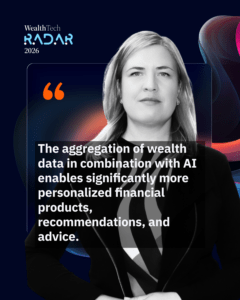
The combination of comprehensive asset data and AI-driven analysis fundamentally changes the quality of financial advisory. Regulatory processes such as completing the securities suitability questionnaire (WpHG) can be automated on the basis of existing portfolio data. Behavioral patterns and life events can be incorporated into financial planning. Portfolio balancing and personalized product recommendations become scalable. Susanne Krehl articulates the core thesis of the chapter directly: “The aggregation of wealth data combined with AI enables significantly more personalized financial products, recommendations, and advisory services.”
Challenges: Data Quality, Security, Compliance
Implementation places concrete technical and organizational demands on institutions. Financial data from disparate sources is frequently fragmented or inconsistent. Established providers address this through dynamic, AI-assisted mapping that enforces a uniform data standard across multiple interfaces. In parallel, stringent requirements apply to data security and regulatory compliance — ISO 27001 certification and DORA conformity are relevant benchmarks when evaluating providers.
Market Development
The growth dynamics in this segment are quantifiable: according to Juniper Research, API calls in Open Banking will rise from 137 billion to 722 billion by 2029. Wealth Aggregation is no longer a niche topic — it is becoming a core infrastructure component for competitive financial services.
WealthTech Radar 2026
Susanne Krehl’s chapter is part of the WealthTech Radar 2026, published by Fincite together with twelve industry experts from banks, WealthTechs, and advisory firms. The report is available free of charge at: fincite.de/knowledge-hub/wealthtech-radar-2026
wealthAPI Blog
wealthAPI Featured in Bitkom White Paper: Compliance Automation as a Real-World Use Case
In March 2026, the German digital association Bitkom published the white paper "Beyond the Pilot –…

wealthAPI Appoints Nicola Breyer as Open Finance Expert to Advisory Board
Berlin, February 10th, 2026 - wealthAPI, the leading provider of data and API solutions for the…
wealthAPI is now ISO27001 certified
IT security is an important part of our daily work, and ISO/IEC 27001 certification underscores our…